Exit Into History: A Journey through the New Eastern Europe
In this arresting, intimate narrative journey, award-winning Eva Hoffman returns to her Polish homeland and five other countries—Hungary, Romania, Bulgaria, and the two nations of the former Czechoslovakia—historically transformed by the demise of Communism. The result is the penetrating personal odyssey across the “other Europe” and a vivid portrayal of a landscape in the midst of change. Hoffman combines the wise perspective of an outsider and the passionate concern of a native daughter to illuminate the forces informing the region’s complex politics as she captures the texture of everyday life in a world in flux.
John Reed’s Ten Days that Shook the World, published in 1922, is a gripping account of the Russian Revolution that took place just years earlier in the midst of World War I. Of course, nobody knew at the time just how important the Russian Revolution would be geopolitically, especially with the advent of the Cold War less than 25 years later. Reed’s account was firsthand; as a journalist, he was in Russia when the Revolution transpired. The book was popular and influential enough that it made the rounds among Russia’s leadership, with Stalin himself arguing against some of Reed’s theses.
What the Kosovars Say and Demand: Collection of Studies, Articles, Interviews, and Commentaries Vol 2
This volume is the second part of the book What the Kosovars Say and Demand. Like the first volume, it includes interviews, talks and various articles published by intellectuals and other citizens of Kosovo in recent months in the Yugoslav and foreign press.
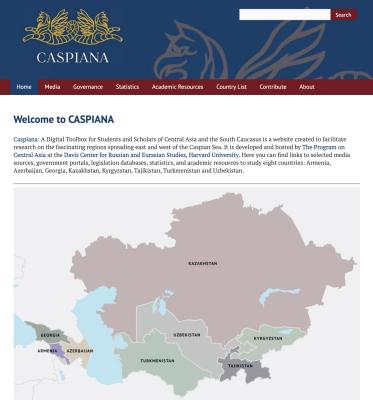
Caspiana: A Digital Toolbox for Students and Scholars of Central Asia and the South Caucasus
Caspiana: A Digital Toolbox for Students and Scholars of Central Asia and the South Caucasus is a website created to facilitate research on the fascinating regions spreading east and west of the Caspian Sea. It is developed and hosted by The Program on Central Asia at the Davis Center for Russian and Eurasian Studies, Harvard University. Here you can find links to selected media sources, government portals, legislation databases, statistics, and academic resources to study eight countries: Armenia, Azerbaijan, Georgia, Kazakhstan, Kyrgyzstan, Tajikistan, Turkmenistan and Uzbekistan.
The website presents samples of original texts alongside their Russian translations. The comparison helps one not only to see the translator’s method and principles, but also to get an idea of how Russian readers understood and interpreted European political treatises throughout the “long” eighteenth century.
The website also provides a context for the key political concepts that entered the Russian language at the time. When the different contexts of a certain concept are put in chronological order, it will be possible to see how political terms changed their meaning, in other words, how the language and the semantics of Russian political culture evolved.
The database will provide scholars with a basis for further research in the history of language and political thought in Russia and will allow researchers and lovers of history to expand their understanding of the political discourse of eighteenth-century Russia.
Q*ASEEES Syllabi Collection on Queer Eastern Europe
The Society for the Promotion of LGBTQ Slavic, East European, & Eurasian Studies (Q*ASEEES) has launched a resources page on its website. Currently, the syllabi section is available, where you can have a look at diverse courses on queer Eastern Europe that have been taught in the USA, Europe, and Russia.
The fully digitized collection includes 74 items: 73 color posters and 1 map, dating 1894-1970. The items are subdivided into four groups: Soviet propaganda posters in Yiddish and Russian (1917-1940); Soviet theater and concert posters in Yiddish and Russian (1924-1970); movie posters from USSR and Mandate Palestine in Russian, Yiddish, French, English, and Hebrew (1926-1932); Yugoslav antisemitic propaganda posters in Serbian (1941-1942).
The largest group—Soviet propaganda posters in Yiddish and Russian—includes 25 items. These posters were published by the Bolshevik party propaganda organs to promote Soviet policies among the Jews such as transforming the Jews into “active builders of socialist society” (https://www.blavatnikarchive.org/item/22962).
6 Soviet theater and concert posters in Yiddish and Russian advertise theatrical performances, concerts, and literary evenings in various USSR cities, starting from Russian-Yiddish comedy show in Poltava in the 1920s (https://www.blavatnikarchive.org/item/22954), to the 1936 Moscow literary evening celebrating the 100th anniversary of classical Yiddish writer Mendele Mocher Sforim (https://www.blavatnikarchive.org/item/22959), and to Yiddish song concert in Moscow in 1970 (https://www.blavatnikarchive.org/item/34423).
13 movie posters from USSR and Mandate Palestine in Russian, Yiddish, French, English, and Hebrew advertise movies, which run at the “Eden” summer movie theater in Tel Aviv, in 1926-1930, including Hollywood pictures and films produced in USSR. There are also posters advertising one of first the Soviet sound movies, “The Return of Nathan Becker,” released in 1932 in both Russian and Yiddish (https://www.blavatnikarchive.org/item/22971).
23 Yugoslav antisemitic propaganda posters in Serbian were a part of a Nazi antisemitic propaganda campaign during the World War II, based on a “theory” of Judeo-Masonic conspiracy to win domination of the world. These posters were exhibited and distributed at the Grand Anti-Masonic Exhibition held from October 22, 1941 to January 19, 1942 in Belgrade, the capital of the Nazi Germany-established Military Administration Authority in occupied Serbia. These posters include the intimidating imagery of the conspirators and their weapons, such as the poster, “His Weapons: Democracy, Masonry, Communism, Capitalism” (https://www.blavatnikarchive.org/item/22977).
The Judaica Posters collection at the BAF opens a window on the twentieth-century most radical ideologies and policies toward the Jews, conceived and implemented by Communist regime in USSR in the 1920s-1930s and Nazi regime in Germany and Germany-occupied Europe in the 1940s. Ideological content of many posters is reinforced by the cutting-edge art created by leading avant-garde artists. Collection materials also reveal various forms of Jewish cultural life, including film, theater, literature, and music, in USSR and Mandate Palestine in the 1920s-1930s.
The Blavatnik Archive Foundation (http://www.blavatnikarchive.org) is a nonprofit foundation dedicated to preserving and disseminating primary resources that contribute to the study of 20th-century Jewish and world history, with a special emphasis on World War I, World War II, Soviet and interwar periods. The Archive was founded in 2005 by American industrialist and philanthropist Len Blavatnik, to reflect his commitment to his family heritage, to explore his interests in historical events and people, and to expand his support for primary source-based scholarship and education. Currently, the Archive’s holdings of over 90,000 items include video oral histories, postcards, photographs, posters, drawings and illustrations, diaries, letters and documents, periodicals, leaflets and books.
Hosted by the interim director of the Polish Studies Center, Dr. Elizabeth Cullen Dunn (Geography), i tak dalej... will bring you topical interviews with scholars, experts, activists, and more on all things Polish throughout the coming year.
i tak dalej can be listened to via the following podcast apps: