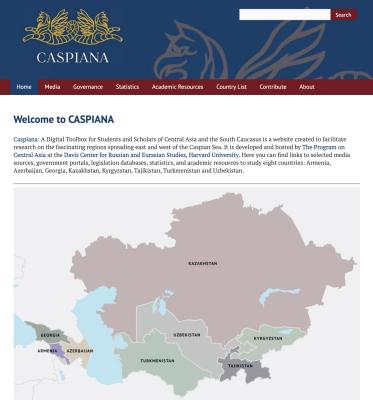
Caspiana: A Digital Toolbox for Students and Scholars of Central Asia and the South Caucasus
Caspiana: A Digital Toolbox for Students and Scholars of Central Asia and the South Caucasus is a website created to facilitate research on the fascinating regions spreading east and west of the Caspian Sea. It is developed and hosted by The Program on Central Asia at the Davis Center for Russian and Eurasian Studies, Harvard University. Here you can find links to selected media sources, government portals, legislation databases, statistics, and academic resources to study eight countries: Armenia, Azerbaijan, Georgia, Kazakhstan, Kyrgyzstan, Tajikistan, Turkmenistan and Uzbekistan.
Между нами is a free, web-based textbook that provides a comprehensive introduction to Russian language and culture. It is organized around the experiences of four American students, each spending the academic year in a different Russian city. Their interactions with host families, roommates, fellow students and teachers create a universe of contextualized information that motivates the use of the target language in the classroom.
The Slavic department at Stockholm university has developed a very efficient language learning tool, Wordalist: www.wordalist.com
Main features:
- Statistics driven practice engine: Wordalist gathers data and gets to know each individual user and presents questions the user needs to practice more often, and those the user knows better less often, thus optimizing user experience and learning efficiency. Data from all users is also used in the algorithm; Wordalist knows which questions are hard and which are not.
- Extremely user friendly interface strictly focused on learning: we’ve stripped the layout from all distractions. It’s only you and your exercise. No obstacles; everything can be handled from your keyboard - just type your answer and hit enter and you’ll get the correct answer along with the next question. Wordalist is made with daily use in mind; there is nothing to distract you or irritate you. Our goal has been to create a feeling of ”flow”. Wordalist works both on computers and mobile devices.
- Creating new exercises and editing existing content is very simple and straightforward. You can also export and import questions with standard csv-files.
No learning tool, however competent, is worth using unless it contains high quality learning content. This is also the problem with many of the tools you find on the internet; they rely to heavy on the amateur user for content. In Wordalist anyone can set up new exercises, so students use it for their purposes of course, but the core learning content is created by professionals and you can easily find these exercises by filtering out content by popularity and/or size. Naturally we hope you will find Wordalist useful and choose to contribute and create your own exercises, but to get your students started we’re translating a quite extensive vocabulary exercise from Swedish/Russian to English/Russian. Altogether approximately 2400 words/questions divided into three main levels and sub-divided into sections to enable a progression from absolute beginner to intermediate:
Foreigncy is a tool owned and maintained by the Center for Educational Resources in Culture, Language and Literacy (CERCLL), a Language Resource Center at the University of Arizona. Foreigncy was donated to CERCLL in 2020 by University of Arizona alumnus Alex Sorin who credits the university with playing a key role in his career and language learning journey. Foreigncy was built out of a passion for language learning and to provide a service for higher-level students in a market flooded with beginner level tools that simply don’t cut it for intermediate to advanced-level language learners. Once you’ve attained intermediate to advanced level proficiency, you need a tool that can help you improve or maintain your language skills and prepare you to use your skills professionally. Foreigncy bridges this gap by providing language courses carefully designed for intermediate to advanced-level language learners on a wide variety of topics. Whether you’re a university student or language professional, Foreigncy is committed to helping you take your language skills to the next level and turn your passion for languages into a calling.
Polonicum: Center for Polish Language and Culture for Foreigners, University of Warsaw
The Centre of Polish Language and Culture for Foreigners “Polonicum” is the oldest centre of its kind in Poland. Throughout the entire academic year it organises various courses and workshops teaching the Polish language and culture to foreigners. Among the participants of those courses are students of the University of Warsaw and of other Warsaw institutions of higher education, as well as numerous foreigners interested in the language and culture of our country. The “Polonicum” is a section of the Faculty of Polish Studies of the University of Warsaw operating as a foreign language school; thus the courses it offers are not specialisation or optional courses, and it does not provide the regular course of studies. The main areas of the “Polonicum”’ activity involve educating foreigners in the fields of the language, history and culture of Poland, training the future teachers of Polish as a foreign language, cooperation with the embassies, departments of Polish Studies and Institutes of Polish Culture abroad, organising meetings and national and international conferences, writing and publishing textbooks and teaching materials.
The MERLOT system provides access to curated online learning and support materials and content creation tools, led by an international community of educators, learners and researchers.
MiniLessons are free language lessons for lower intermediate to advanced students. They are mostly in Russian, but occasionally cover other Eurasian langauges as well. Developed by SRAS, these bilingual resources feature Russian phrases inserted to English texts to help you build your vocabulary. The texts cover multiple topics. Use the “search by subject” option under “Languages” in the main menu if you are looking for something specific.
Foreign Language Teaching Podcast brings you interviews with experienced teachers, SLA and bilingualism experts, textbook authors, and scholars who share their thoughts on teaching foreign languages and reflect on the best practices and strategies that will help you in your classroom.
These free intermediate Russian lessons are hosted by Roxana Burkhanova, a recent graduate of Moscow State University. She discusses modern life, history, sociology, and politics in simplified Russian. Each text is glossed for vocabulary and cultural meaning and comes with a related grammar lesson. Roxana served as SRAS Moscow Student Coordinator in 2015-2016 and developed many ideas for this series in via her conversations with SRAS students.