Turkey

MEDLI: the Middle Eastern & Mediterranean Language Institute at UW-Madison. For Summer 2023, we have additional FLAS funding opportunities and spaces available on our Turkish programs at all levels, in case any of your students are in need of funding or summer Turkish language options at a specific level. 

Also, if you have any students interested in learning Modern Hebrew at the Elementary Level this summer, we are offering students an automatic 50% tuition remission for that program.

Apply Here:

https://medli.wisc.edu/application/
For more information contact us at medli@lpo.wisc.edu

Inventing Laziness: The Culture of Productivity in Late Ottoman Society, a book talk with Professor Melis Hafez, Virginia Commonwealth University.

The author explores what we can learn about Ottoman history over the long nineteenth-century by looking closely into the contested and shifting boundaries of the laziness - productivity binary. Hafez also considers how 'laziness' can be used to understand emerging civic culture and its exclusionary practices in the Ottoman Empire.

Lecture, In person at ANAMED Auditorium, İstiklal Caddesi, 181, Merkez Han, Beyoğlu and streamed online.
Date: January 31, 2023

Time: 6:00 pm (Istanbul, UTC + 3),10:00 am EST (New York).


For the online presentation, please Register here.  For more information, please see https://aritweb.org/events/ or write to aritevents@gmail.com.

If it isn’t broke: Regional Shipbuilding Traditions and Maritime Networks in the Ancient Mediterranean, an online seminar with Professor Paul Salay, Coe College. 

Dr. Salay applies the geo-spatial tools of Geographic Information Systems (GIS) to create a picture of the development and increasing complexity of maritime connectivity and transport from the Late Archaic to the Early Empire.

Date: January 27, 2023

Time: 7:00 pm (Istanbul, UTC + 3),11:00 am EST (New York).


Please Register here.  For more information, please see https://aritweb.org/events/ or write to aritevents@gmail.com.

MEHAT/ISRG welcomes presentation proposals from graduate students (MA or PhD) and faculty/staff in any department or program related to Islamicate societies past or present. We are particularly eager to facilitate interdisciplinary collaboration with those working beyond the contemporary boundaries of the Middle East. 

To apply please send a brief personal introduction, a title, and a paragraph or two about your intended presentation to Theo Knights. We will be reviewing applications on a rolling basis. Our desire is for the workshop to be a low stress place for students and faculty to receive collegial feedback on current, or very recently published work so please do consider applying!

the The Kentucky Foreign Language Conference (KFLC) is pleased to invite scholars from all disciplines in Slavic, Eurasian, and East European studies to submit proposals for individual papers and panels at its annual meeting to be held from Thursday, April 20 through Saturday, April 22. 

Please Visit https://kflc.as.uky.edu/ <https://kflc.as.uky.edu/> to learn more about the conference, create an account, and upload your abstract(s) by 11:59pm on Tuesday, November 1, 2022.

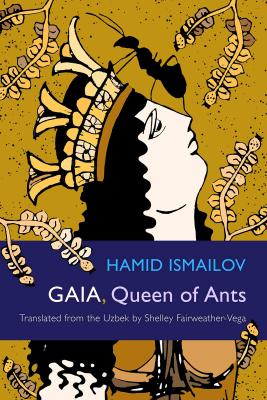
Hamid Ismailov
Gaia, Queen of Ants (Syracuse University Press, 2020)

From Uzbek author-in-exile Hamid Ismailov comes a dark new parable of power, corruption, fraud and deception. Ismailov narrates an intimate clash of civilizations and mythologies as he follows the lives of three expatriates living in England. Domrul is a young Turk with vague and painful memories of ethnic strife in the Uzbekistan of his childhood. His Irish girlfriend Emer struggles with her own adolescent trauma from growing up in war-torn Bosnia. Domrul is the caretaker for Gaia, the eighty-year-old, powerful wife of a Soviet party boss with a mysterious past. All three are connected to Kuyuk, a traditional Central Asian bard.

One of Ismailov's few novels written in Uzbek, Gaia, Queen of Ants offers a rare portrait of a complex and little-known part of the world. A plot centered on political corruption and ethnic conflict is punctuated with Sufi philosophy and religious gullibility. As Ismailov's characters grapple with questions of faith, power, sex, and family, Gaia, Queen of Ants presents a moving tale of universal themes set against a Central Asian backdrop in the twenty-first century. 

Subscribe to Turkey