Politics/Current Events

Emma Gilligan
Terror in Chechnya (Princeton University Press, 2010)

Terror in Chechnya

Terror in Chechnya is the definitive account of Russian war crimes in Chechnya. Emma Gilligan provides a comprehensive history of the second Chechen conflict of 1999 to 2005, revealing one of the most appalling human rights catastrophes of the modern era--one that has yet to be fully acknowledged by the international community. Drawing upon eyewitness testimony and interviews with refugees and key political and humanitarian figures, Gilligan tells for the first time the full story of the Russian military's systematic use of torture, disappearances, executions, and other punitive tactics against the Chechen population.

In Terror in Chechnya, Gilligan challenges Russian claims that civilian casualties in Chechnya were an unavoidable consequence of civil war. She argues that racism and nationalism were substantial factors in Russia's second war against the Chechens and the resulting refugee crisis. She does not ignore the war crimes committed by Chechen separatists and pro-Moscow forces. Gilligan traces the radicalization of Chechen fighters and sheds light on the Dubrovka and Beslan hostage crises, demonstrating how they undermined the separatist movement and in turn contributed to racial hatred against Chechens in Moscow.

A haunting testament of modern-day crimes against humanity, Terror in Chechnya also looks at the international response to the conflict, focusing on Europe's humanitarian and human rights efforts inside Chechnya. 

Anna Politkovskaya
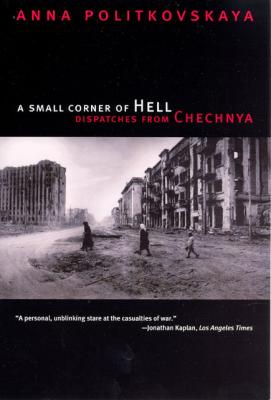
A Small Corner of Hell: Dispatches from Chechnya (University of Chicago Press, 2003)

A Small Corner of Hell: Dispatches from Chechnya

Chechnya, a 6,000-square-mile corner of the northern Caucasus, has struggled under Russian domination for centuries. The region declared its independence in 1991, leading to a brutal war, Russian withdrawal, and subsequent "governance" by bandits and warlords. A series of apartment building attacks in Moscow in 1999, allegedly orchestrated by a rebel faction, reignited the war, which continues to rage today. Russia has gone to great lengths to keep journalists from reporting on the conflict; consequently, few people outside the region understand its scale and the atrocities—described by eyewitnesses as comparable to those discovered in Bosnia—committed there.

Anna Politkovskaya, a correspondent for the liberal Moscow newspaper Novaya gazeta, was the only journalist to have constant access to the region. Her international stature and reputation for honesty among the Chechens allowed her to continue to report to the world the brutal tactics of Russia’s leaders used to quell the uprisings. A Small Corner of Hell: Dispatches from Chechnya is her second book on this bloody and prolonged war. More than a collection of articles and columns, A Small Corner of Hell offers a rare insider’s view of life in Chechnya over the past years. Centered on stories of those caught-literally-in the crossfire of the conflict, her book recounts the horrors of living in the midst of the war, examines how the war has affected Russian society, and takes a hard look at how people on both sides are profiting from it, from the guards who accept bribes from Chechens out after curfew to the United Nations. Politkovskaya’s unflinching honesty and her courage in speaking truth to power combine here to produce a powerful account of what is acknowledged as one of the most dangerous and least understood conflicts on the planet.

Anna Politkovskaya was assassinated in Moscow on October 7, 2006.

R.J. Crampton
A Concise History of Bulgaria, 2nd Edition (Cambridge University Press, 2005)

A Concise History of Bulgaria, 2nd Edition

Richard Crampton presents a general introduction to Bulgaria at the cross-roads of Christendom and Islam. This concise history traces the country's growth from pre-history, through its days as the center of a powerful medieval empire and five centuries of Ottoman rule, to the political upheavals of the twentieth century which led to three wars. It highlights 1995 to 2004, a vital period during which Bulgaria endured financial meltdown, set itself seriously on the road to reform, elected its former King as prime minister, and finally secured membership in NATO and admission to the European Union.

Yegor Gaidar
Collapse of an Empire: Lessons for Modern Russia (Brookings Institution Press, 2007)

Collapse of an Empire: Lessons for Modern Russia

The Soviet Union was an empire in many senses of the word—a vast mix of far-flung regions and accidental citizens by way of conquest or annexation. Typical of such empires, it was built on shaky foundations. That instability made its demise inevitable, asserts Yegor Gaidar, former prime minister of Russia and architect of the "shock therapy" economic reforms of the 1990s. Yet a growing desire to return to the glory days of empire is pushing today's Russia backward into many of the same traps that made the Soviet Union untenable. In this important new book, Gaidar clearly illustrates why Russian nostalgia for empire is dangerous and ill-fated: "Dreams of returning to another era are illusory. Attempts to do so will lead to defeat." Gaidar uses world history, the Soviet experience, and economic analysis to demonstrate why swimming against this tide of history would be a huge mistake. The USSR sowed the seeds of its own economic destruction, and Gaidar worries that Russia is repeating some of those mistakes. Once again, for example, the nation is putting too many eggs into one basket, leaving the nation vulnerable to fluctuations in the energy market. The Soviets had used revenues from energy sales to prop up struggling sectors such as agriculture, which was so thoroughly ravaged by hyperindustrialization that the Soviet Union became a net importer of food. When oil prices dropped in the 1980s, that revenue stream diminished, and dependent sectors suffered heavily. Although strategies requiring austerity or sacrifice can be politically difficult, Russia needs to prepare for such downturns and restrain spending during prosperous times. Collapse of an Empire shows why it is imperative to fix the roof before it starts to rain, and why sometimes the past should be left in the past.

Steve LeVine
Putin's Labyrinth: Spies, Murder, and the Dark Heart of the New Russia (Random House, 2008)

Putin's Labyrinth: Spies, Murder, and the Dark Heart of the New Russia

In Putin’s Labyrinth, acclaimed journalist Steve LeVine, who lived in and reported from the former Soviet Union for more than a decade, provides a gripping account of modern Russia. President Dmitri Medvedev and the country’s real power, Prime Minister Vladimir Putin, are posing a resolute challenge to the West. In a penetrating narrative that recounts the lives and deaths of six Russians, LeVine portrays the growth of a “culture of death”—from targeted assassinations of the state’s enemies to the Kremlin’s indifference when innocent hostages are slaughtered. Interviews with eyewitnesses and the families and friends of these victims reveal how Russians manage to negotiate their way around the ever-present danger of violence and the emotional toll that this lethal maze is exacting on ordinary people. The result is a fresh way of assessing the forces that are driving this major new confrontation with the West.

Steve LeVine
The Oil and the Glory: The Pursuit of Empire and Fortune on the Caspian Sea (Random House, 2007)

The Oil and the Glory: The Pursuit of Empire and Fortune on the Caspian Sea

Remote, forbidding, and volatile, the Caspian Sea long tantalized the world with its vast oil reserves. But outsiders, blocked by the closed Soviet system, couldn’t get to it. Then the Soviet Union collapsed, and a wholesale rush into the region erupted. Along with oilmen, representatives of the world’s leading nations flocked to the Caspian for a share of the thirty billion barrels of proven oil reserves at stake, and a tense geopolitical struggle began. The main players were Moscow and Washington–the former seeking to retain control of its satellite states, and the latter intent on dislodging Russia to the benefit of the West.

The Oil and the Glory is the gripping account of this latest phase in the epochal struggle for control of the earth’s “black gold.” Steve LeVine, who was based in the region for The Wall Street Journal, The New York Times, and Newsweek, weaves an astonishing tale of high-stakes political gamesmanship, greed, and scandal, set in one of the most opaque corners of the world. In LeVine’s telling, the world’s energy giants jockey for position in the rich Kazakh and Azeri oilfields, while superpowers seek to gain a strategic foothold in the region and to keep each other in check. At the heart of the story is the contest to build and operate energy pipelines out of the landlocked region, the key to controlling the Caspian and its oil. The oil pipeline that resulted, the longest in the world, is among Washington’s greatest foreign policy triumphs in at least a decade and a half.

Along the way, LeVine introduces such players as James Giffen, an American moneyman who was also the political “fixer” for oil companies eager to do business on the Caspian and the broker for Kazakhstan’s president and ministers; John Deuss, the flamboyant Dutch oil trader who won big but lost even bigger; Heydar Aliyev, the oft-misunderstood Azeri president who transcended his past as a Soviet Politburo member and masterminded a scheme to loosen Russian control over its former colonies in the Caspian region; and all manner of rogues, adventurers, and others drawn by the irresistible pull of untold riches and the possible “final frontier” of the fossil-fuel era. The broader story is of the geopolitical questions of the Caspian oil bonanza, such as whether Russia can be a trusted ally and trading partner with the West, and what Washington’s entry into this important but chaotic region will mean for its long-term stability.

Ramiz Mehdiyev
Azerbaijan - 2003-2008: Thinking about Time (Şərq-Qərb Nəşriyyat Evi, 2010)

Azerbaijan - 2003-2008: Thinking about Time

A book by academic and former head of the Office of the President of Azerbaijan. English version of the text: Azərbaycan – 2003-2008: Zaman Haqqında Düşünərkən.

Subscribe to Politics/Current Events