
Central Asia

Islam, Asia, Modernity (Henry M. Jackson School of International Studies at the University of Washington, 2005)

Islam, Asia, Modernity

On May 5-8, 2005, the Jackson School of International Studies' Asia Centers held an open conference and symposium entitles Islam, Asia, Modernity at the University of Washington, Seattle campus. This exciting event brought together preeminent scholars and public intellectuals from Asia, Europe, and the United States to share their expertise about the changing practices and politics of Asian Islam. The conference consisted of a public lecture by the cultural theorist Ziauddin Sardar, two days of panel discusiions, and a pedagogy workshop for invited advanced graduate students preparing to teach about Islam in Asia. This DVDs record the lecutres and discussions. While the topic areas were global in scope, several speakers focus on Islam in Central Asia and the Former Soviet Union.

Ezra Malakov
Musical Treasures of the Bukharian Jewish Community (World Bukharian Jewish Congress, 2007)

Musical Treasures of the Bukharian Jewish Community

A seven CD box-set with book of music and lyrics. This remarkable collection represents a thorough overview of the religious and folk music of the Bukharian Jewish Community, once based in Uzbekistan, Tajikistan, and elsewhere in Central Asia. Collected by Ezra Malakov, an accomplished musician and performer from Uzbekistan, this box-set is a delightful way to introduce music lovers, both young and old, to the musical traditions of Central Asia. It is the perfect accompaniment to learning units on folk music, world music, the Silk Road, Central Asia, the successor states to the Soviet Union, and world religion. Listen, Learn, and Enjoy!

Some tracks are available online here: https://www.musicofcentralasia.org/Tracks/Chapter/26 

Paul Stronski
Tashkent: Forging a Soviet City, 1930-1966 (University of Pittsburgh Press, 2010)

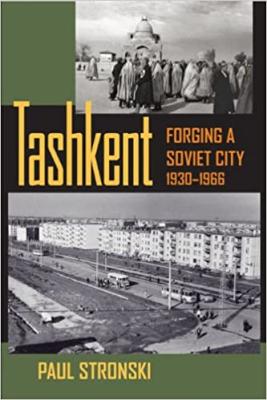
Tashkent: Forging a Soviet City, 1930-1966

Paul Stronski tells the fascinating story of Tashkent, an ethnically diverse, primarily Muslim city that became the prototype for the Soviet-era reimagining of urban centers in Central Asia. Based on extensive research in Russian and Uzbek archives, Stronski shows us how Soviet officials, planners, and architects strived to integrate local ethnic traditions and socialist ideology into a newly constructed urban space and propaganda showcase.

The Soviets planned to transform Tashkent from a “feudal city” of the tsarist era into a “flourishing garden,” replete with fountains, a lakeside resort, modern roadways, schools, hospitals, apartment buildings, and of course, factories. The city was intended to be a shining example to the world of the successful assimilation of a distinctly non-Russian city and its citizens through the catalyst of socialism. As Stronski reveals, the physical building of this Soviet city was not an end in itself, but rather a means to change the people and their society.

Stronski analyzes how the local population of Tashkent reacted to, resisted, and eventually acquiesced to the city’s socialist transformation. He records their experiences of the Great Terror, World War II, Stalin’s death, and the developments of the Krushchev and Brezhnev eras up until the earthquake of 1966, which leveled large parts of the city. Stronski finds that the Soviets established a legitimacy that transformed Tashkent and its people into one of the more stalwart supporters of the regime through years of political and cultural changes and finally during the upheavals of glasnost.

Steve LeVine
The Oil and the Glory: The Pursuit of Empire and Fortune on the Caspian Sea (Random House, 2007)

The Oil and the Glory: The Pursuit of Empire and Fortune on the Caspian Sea

Remote, forbidding, and volatile, the Caspian Sea long tantalized the world with its vast oil reserves. But outsiders, blocked by the closed Soviet system, couldn’t get to it. Then the Soviet Union collapsed, and a wholesale rush into the region erupted. Along with oilmen, representatives of the world’s leading nations flocked to the Caspian for a share of the thirty billion barrels of proven oil reserves at stake, and a tense geopolitical struggle began. The main players were Moscow and Washington–the former seeking to retain control of its satellite states, and the latter intent on dislodging Russia to the benefit of the West.

The Oil and the Glory is the gripping account of this latest phase in the epochal struggle for control of the earth’s “black gold.” Steve LeVine, who was based in the region for The Wall Street Journal, The New York Times, and Newsweek, weaves an astonishing tale of high-stakes political gamesmanship, greed, and scandal, set in one of the most opaque corners of the world. In LeVine’s telling, the world’s energy giants jockey for position in the rich Kazakh and Azeri oilfields, while superpowers seek to gain a strategic foothold in the region and to keep each other in check. At the heart of the story is the contest to build and operate energy pipelines out of the landlocked region, the key to controlling the Caspian and its oil. The oil pipeline that resulted, the longest in the world, is among Washington’s greatest foreign policy triumphs in at least a decade and a half.

Along the way, LeVine introduces such players as James Giffen, an American moneyman who was also the political “fixer” for oil companies eager to do business on the Caspian and the broker for Kazakhstan’s president and ministers; John Deuss, the flamboyant Dutch oil trader who won big but lost even bigger; Heydar Aliyev, the oft-misunderstood Azeri president who transcended his past as a Soviet Politburo member and masterminded a scheme to loosen Russian control over its former colonies in the Caspian region; and all manner of rogues, adventurers, and others drawn by the irresistible pull of untold riches and the possible “final frontier” of the fossil-fuel era. The broader story is of the geopolitical questions of the Caspian oil bonanza, such as whether Russia can be a trusted ally and trading partner with the West, and what Washington’s entry into this important but chaotic region will mean for its long-term stability.

Eric McGlinchey
Chaos, Violence, Dynasty: Politics and Islam in Central Asia (University of Pittsburgh, 2011)

Chaos, Violence, Dynasty: Politics and Islam in Central Asia

In the post-Soviet era, democracy has made little progress in Central Asia. In Chaos, Violence, Dynasty, Eric McGlinchey presents a compelling comparative study of the divergent political courses taken by Kyrgyzstan, Uzbekistan, and Kazakhstan in the wake of Soviet rule. McGlinchey examines economics, religion, political legacies, foreign investment, and the ethnicity of these countries to evaluate the relative success of political structures in each nation.

McGlinchey explains the impact of Soviet policy on the region, from Lenin to Gorbachev. Ruling from a distance, a minimally invasive system of patronage proved the most successful over time, but planted the seeds for current “neo-patrimonial” governments. The level of direct Soviet involvement during perestroika was the major determinant in the stability of ensuing governments. Soviet manipulations of the politics of Uzbekistan and Kazakhstan in the late 1980s solidified the role of elites, while in Kyrgyzstan the Soviets looked away as leadership crumbled during the ethnic riots of 1990. Today, Kyrgyzstan is the poorest and most politically unstable country in the region, thanks to a small, corrupt, and fractured political elite. In Uzbekistan, Islam Karimov maintains power through the brutal suppression of disaffected Muslims, who are nevertheless rising in numbers and influence. In Kazakhstan, a political machine fueled by oil wealth and patronage underlies the greatest economic equity in the region, and far less political violence.

McGlinchey’s timely study calls for a more realistic and flexible view of the successful aspects of authoritarian systems in the region that will be needed if there is to be any potential benefit from foreign engagement with the nations of Central Asia, and similar political systems globally.

Caspiana: A Digital Toolbox for Students and Scholars of Central Asia and the South Caucasus (Davis Center for Russian and Eurasian Studies, Harvard University, 2021)

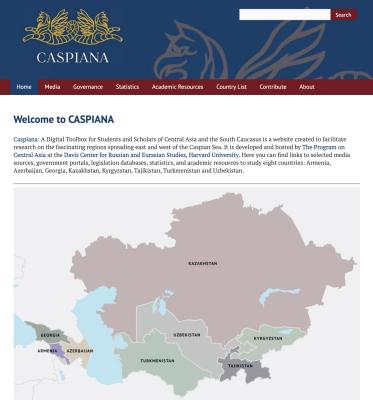
Caspiana: A Digital Toolbox for Students and Scholars of Central Asia and the South Caucasus

Caspiana: A Digital Toolbox for Students and Scholars of Central Asia and the South Caucasus is a website created to facilitate research on the fascinating regions spreading east and west of the Caspian Sea. It is developed and hosted by The Program on Central Asia at the Davis Center for Russian and Eurasian StudiesHarvard University. Here you can find links to selected media sources, government portals, legislation databases, statistics, and academic resources to study eight countries: Armenia, Azerbaijan, Georgia, Kazakhstan, Kyrgyzstan, Tajikistan, Turkmenistan and Uzbekistan.

Access at: https://caspiana.omeka.fas.harvard.edu/

Sean Guillory
Sean's Russia Blog Podcast (University of Pittsburgh)

Sean's Russia Blog Podcast

The SRB Podcast’s mission is simple: to provide a space for the many, many interesting thinkers who do amazing work to express their views, discuss their work, and contribute to the larger public discussion on the region. The show also seeks to give the public access to the wonderful and growing body of research that rarely reaches a broad audience but is crucially important, especially as tensions with and in the region flare. It is my hope the SRB Podcast will make a modest contribution to paint a picture of Eurasia in all its complexity and the spread knowledge about it to an interested public.

https://srbpodcast.org/

China, Russia, and the Global Politics of COVID-19 Vaccines

What role are COVID-19 vaccines developed in China and Russia playing during a moment marked by widespread vaccine nationalism and global efforts to ensure equitable access? This webinar brings together a group of social scientists to discuss the politics of these vaccines.

April 21 @ 12:00 CT via Zoom

Register to attend online at https://bit.ly/2OPRfME



Online Primary Sources (Centre for Russian, Caucasian and Central European Studies, 2021)

The Online Primary Sources database aims to provide researchers and students with sources from Russia, the Caucasus, Central Asia, Eastern and Central Europe put online in recent years thanks to intensive library digitization policies in these zones as well as in the West.

The database is curated by the Centre for Russian, Caucasian and Central European Studies (CERCEC), in Paris (France). CERCEC is a CNRS-EHESS joint research unit. Read more about CERCEC here.

Access the database here: https://onlineprimarysources.cercec.fr/

Subscribe to Central Asia