History/Area Studies

Masha Gessen
Never Remember: Searching for Stalin's Gulags in Putin's Russia (Columbia Global Reports, 2018)

A haunting literary and visual journey deep into Russia's past–and present. 

The Gulag was a monstrous network of labor camps that held and killed millions of prisoners from the 1930s to the 1950s. More than half a century after the end of Stalinist terror, the geography of the Gulag has been barely sketched and the number of its victims remains unknown. Has the Gulag been forgotten? 

Writer Masha Gessen and photographer Misha Friedman set out across Russia in search of the memory of the Gulag. They journey from Moscow to Sandarmokh, a forested site of mass executions during Stalin's Great Terror; to the only Gulag camp turned into a museum, outside of the city of Perm in the Urals; and to Kolyma, where prisoners worked in deadly mines in the remote reaches of the Far East. They find that in Vladimir Putin's Russia, where Stalin is remembered as a great leader, Soviet terror has not been forgotten–it was never remembered in the first place.

Photographs by Misha Friedman. 

Katherine Verdery
My Life as a Spy: Investigations in a Secret Police File (Duke University Press)

As Katherine Verdery observes, "There's nothing like reading your secret police file to make you wonder who you really are." In 1973 Verdery began her doctoral fieldwork in the Transylvanian region of Romania, ruled at the time by communist dictator Nicolae Ceaușescu. She returned several times over the next twenty-five years, during which time the secret police–the Securitate–compiled a massive surveillance file on her. Reading through its 2,781 pages, she learned that she was "actually" a spy, a CIA agent, a Hungarian agitator, and a friend of dissidents: in short, an enemy of Romania. In My Life as a Spy she analyzes her file alongside her original field notes and conversations with Securitate officers. Verdery also talks with some of the informers who were close friends, learning the complex circumstances that led them to report on her, and considers how fieldwork and spying can easily be confused. Part memoir, part detective story, part anthropological analysis, My Life as a Spy offers a personal account of how government surveillance worked during the Cold War and how Verdery experienced living under it. 

Mendel Osherowitch
How People Live in Soviet Russia: Impressions from a Journey (Kashtan Press, 2020)

"Overlooked by mainstream scholarship for far too long, Mendel Osherowitch's book, How People Live in Soviet Russia, is one of the most penetrating and moving accounts of daily life in Soviet Ukraine during the Holodomor. Returning as a visitor after having lived in the USA for many decades, Osherowitch expected to witness his cherished socialist ideals being put into practice. Instead he encountered widespread degradation and the fear infusing the everyday existence of Jews and Gentiles alike. Recording his observations with an uncommon level of understanding and insight, Osherowitch produced a book that sheds a new and unexpected light on the history of the Great Famine of 1932-1933. A must-read."

- Professor Serhii Plokhy, Director, Ukrainian Research Institute, Harvard University

"Mendel Osherowitch's account of his visit to Soviet Ukraine in the early winter of 1932 should not be missed by anyone trying to understand the terrible fate of Ukraine at a critical juncture in its history. His mastery of Ukrainian, Yiddish, and Russian, coupled with a winning personality and unobtrusive style of questioning, made it possible for him to talk with a wide spectrum of Ukrainians, Russians and Jews – in the factories and towns, during long train rides, and in casual encounters. He heard Party bosses and newspaper editors defend the horrific conditions people were living under, insisting it was all worthwhile because of the glorious socialist future as yet to come. Meanwhile, the workers and peasants were left baffled and battered by the emptiness of these Soviet promises.

Investigating the regime's ostensible accomplishments, Osherowitch provides heartrending descriptions of broken and starving men, women, and children, Jews and non-Jews alike, all desperate for a piece of bread, all hoping for succour from a sympathetic foreign visitor. His testimony reveals a deeply disturbing picture of the utter destitution of rural and city life just as the Ukrainian nation began suffering the death throes of extinction from an orchestrated famine."

- Professor Norman M. Naimark, Department of HIstory, Stanford University

Edited by Lubomyr Y. Luciuk, translated by Sharon Power.

Miljenko Jergović
Kin (Archipelago Books, 2021)

In this sprawling narrative spanning the twentieth century, Miljenko Jervović looks into the dusty corners of his family's past, illuminating them with a razor-sharp eye. Ordinary, forgotten objects – a grandfather's bee-keeping journals, a rusty benzene lighter, an army-issued raincoat – become the lenses through which Jergović investigates the joys and sorrows of three generations. Kin is in part an ode to Yugoslavia – taking us through the devastation of the First and Second World War, the Cold War, then the Bosnian War of the 1990s, through changing borders and perspectives, through social rituals at graveyards, through long walks within the labyrinths of Sarajevo and his own mottled memories, Jergović renders it all in candid detail. 

Translated by Russell Scott Valentino. 

An Unchosen People: Jewish Political Reckoning in Interwar Poland (Harvard University Press, 2021)

What did the future hold for interwar Europe's largest Jewish community, the font of global Jewish hopes? When intrepid analysts asked these questions on the cusp of the 1930s, they discovered a Polish Jewry reckoning with "no tomorrow." Assailed by antisemitism and witnessing liberalism's collapse, some Polish Jews looked past progressive hopes or religious certainties to investigate what the nation-state was becoming, what powers minority communities really possessed, and where a future might be found–and for whom. 

The story of modern Jewry is often told as one of creativity and contestation. Kenneth B. Moss traces instead a late Jewish reckoning with diasporic vulnerability, nationalism's terrible potencies, Zionism's promises, and the necessity of choice. Moss examines the works of Polish Jewry's most searching thinkers as they confronted political irrationality, state crisis, and the limits of resistance. He reconstructs the desperate creativity of activists seeking to counter despair where they could not redress its causes. And he recovers a lost grassroots history of critical thought and political searching among ordinary Jews, young and powerless, as they struggled to find a viable future for themselves–in Palestine if not in Poland, individually if not communally. 

Focusing not on ideals but on a search for realism, Moss recasts the history of modern Jewish political thought. Where much scholarship seeks Jewish agency over a collective future, An Unchosen People recovers a darker tradition characterized by painful tradeoffs amid a harrowing political reality, making Polish Jewry a paradigmatic example of the minority experience endemic to the nation-state. 

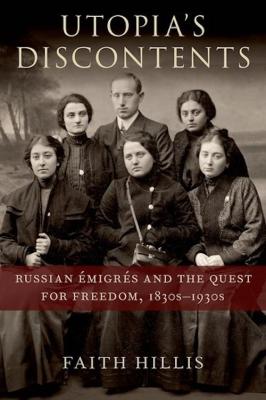
Utopia's Discontents: Russian Émigrés and the Quest for Freedom, 1830s-1930s (Oxford University Press, 2021)

In April 1917, Lenin arrived at Petrograd's Finland Station and set foot on Russian soil for the first time in over a decade. For most of the past seventeen years, the Bolshevik leader had lived in exile, moving between Europe's many "Russian colonies"–large and politically active communities of émigrés in London, Paris, and Geneva, among other cities. Thousands of fellow exiles who followed Lenin on his eastward trek in 1917 were in a similar predicament. The returnees plunged themselves into politics, competing to shape the future of a vast country recently liberated from tsarist rule. yet these activists had been absent from their homeland for so long that their ideas reflected the Russia imagined by residents of the faraway colonies as much as they did events on the ground. The 1917 revolution marked the dawn of a new day in Russian politics, but it also represented the continuation of decades-long conversations that had begun in emigration and were exported back to Russia.

Faith Hillis examines how émigré communities evolved into revolutionary social experiments in the heart of bourgeois cities. Feminists, nationalist activists, and Jewish intellectuals seeking to liberate and uplift populations oppressed by the tsarist regime treated the colonies as utopian communities, creating new networks, institutions, and cultural practices that reflected their values and realized the ideal world of the future in the present. The colonies also influenced their European host societies, informing international debates about the meaning of freedom on both the left and the right. Émigrés' efforts to transform the world played crucial roles in the articulation of socialism, liberalism, anarchism, and Zionism across borders. But they also produced unexpected–and explosive–discontents that defined the course of twentieth-century history. This groundbreaking transnational work demonstrates the indelible marks the Russian colonies left on European politics, legal cultures, and social practices, while underscoring their role during a pivotal period of Russian history. 

Dominique Kirchner Reill
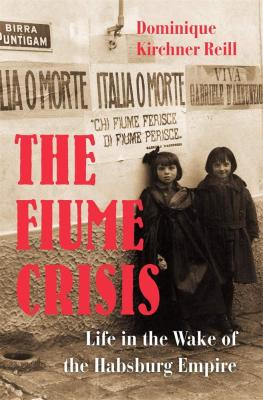
The Fiume Crisis: Life in the Wake of the Habsburg Empire (Harvard University Press, 2020)

The Fiume Crisis recasts what we know about the birth of fascism, the rise of nationalism, and the fall of empire after World War I by telling the story of the three-year period when the Adriatic city of Fiume (today Rijeka, in Croatia) generated an international crisis.

In 1919 the multicultural former Habsburg city was occupied by the paramilitary forces of the flamboyant poet-soldier Gabriele D’Annunzio, who aimed to annex the territory to Italy and became an inspiration to Mussolini. Many local Italians supported the effort, nurturing a standard tale of nationalist fanaticism. However, Dominique Kirchner Reill shows that practical realities, not nationalist ideals, were in the driver’s seat. Support for annexation was largely a result of the daily frustrations of life in a “ghost state” set adrift by the fall of the empire. D’Annunzio’s ideology and proto-fascist charisma notwithstanding, what the people of Fiume wanted was prosperity, which they associated with the autonomy they had enjoyed under Habsburg sovereignty. In these twilight years between the world that was and the world that would be, many across the former empire sought to restore the familiar forms of governance that once supported them. To the extent that they turned to nation-states, it was not out of zeal for nationalist self-determination but in the hope that these states would restore the benefits of cosmopolitan empire.

Against the too-smooth narrative of postwar nationalism, The Fiume Crisis demonstrates the endurance of the imperial imagination and carves out an essential place for history from below.

Lecture 1-1:50 pm
John and Galia Kuo, the leaders of the Chicago-based ensemble Balkan Dances, will give a lecture on Balkan music and dance rhythms.

Workshop 2-3pm

Ensemble Balkan Dance will teach guests the steps of the most popular Balkan dances. In the end, the ensemble will give a mini-performance for the audience.

Exhibit
Hand-made instruments and nineteenth-century folk clothing will be on display during the event.

Subscribe to History/Area Studies